13.3
In the default config
Agentic Browsing landed in Lighthouse's default config in May 2026. Chrome DevTools and PageSpeed Insights are rolling it out on their own schedule.

Pass/fail audits on VTEX IO and FastStore.
A growing share of store traffic comes from software agents, not people. Those agents hit pages built for human eyes and screens, and most stores fail. Lighthouse 13.3.0 now gives you a pass/fail read on whether your site is ready.
Google added Agentic Browsing to Lighthouse's default config. Run an audit on any site and you get a straight answer: can a machine actually use this store?
Agentic Browsing landed in Lighthouse's default config in May 2026. Chrome DevTools and PageSpeed Insights are rolling it out on their own schedule.
Most commerce sites fail these audits out of the box. That includes most VTEX storefronts we have checked so far.
McKinsey finds half of consumers already use AI when searching. Among those who tried it, 44% call it their primary, preferred way to search.
We have not seen a VTEX specialist own this yet. That window will not stay open forever, especially in Brazil and LatAm.
Agent-mediated commerce could reach $3-5 trillion globally by 2030 — McKinsey, Oct 2025.
ChatGPT, Claude, Perplexity, Gemini, and embedded shopping bots do not share one playbook. They still consume the same store artifacts. When those are missing, none of them can buy reliably from your VTEX storefront.
| Readiness layer | What agents consume | Typical VTEX store | What we ship |
|---|---|---|---|
| llms.txt | Machine-readable site summary at the domain root | Missing or invalid | Core package |
| Structured data | JSON-LD on Home, PLP, and PDP with product and offer fields | Sparse | Core package |
| Accessibility tree | Programmatic names on search, cart, filters, and checkout controls | Often missing | Core package |
| Layout stability | Stable layout while pages load so agents do not lose context | Mixed | Core package |
| WebMCP | Declared tools for search, add-to-cart, and order lookup | Not present | Optional later |
We score your store pass/fail on each layer. We do not rank or optimize for a single AI brand.
Agents try indexed feeds first, then crawl your PDP markup, then call APIs when they need live data. The diagram shows where Agent Readiness fits at each step.
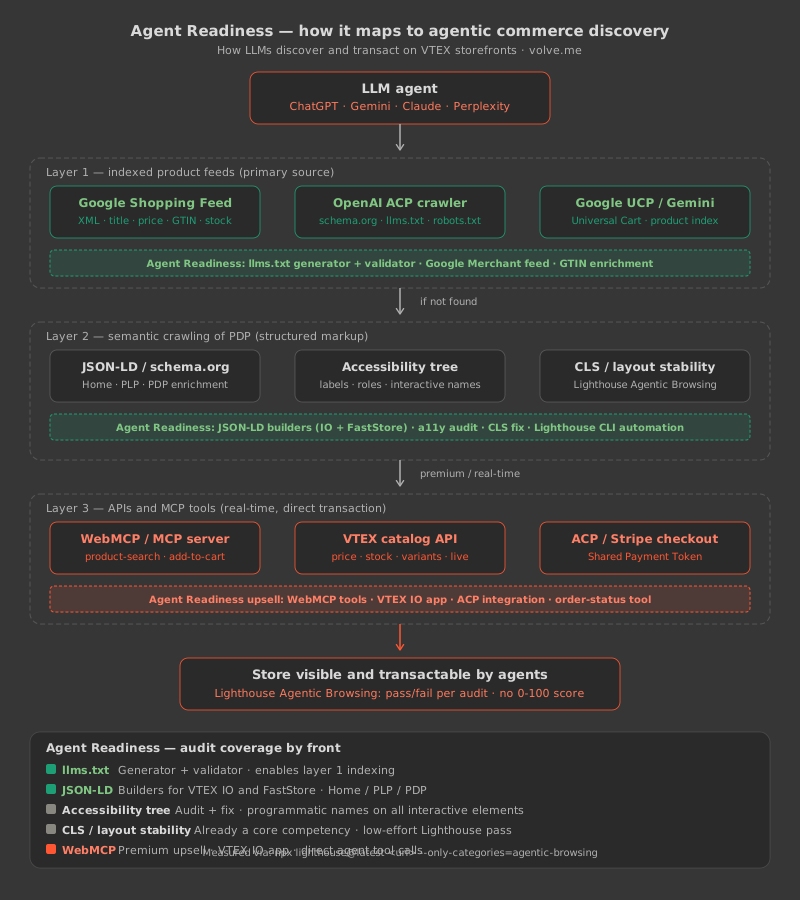
Layer 1 feed tooling and Layer 3 payment integrations are ecosystem paths we can scope separately. The core package covers llms.txt, structured data, accessibility tree, and CLS. ACP, AP2, and MCP are backed by OpenAI, Stripe, Google, Visa, Mastercard, and PayPal — McKinsey, Oct 2025.
Each one maps to a Lighthouse Agentic Browsing check. You pass or fail each item. There is no single score to optimize and walk away from.
"This shift transcends traditional SEO, which stands to become less relevant in an agentic world."
McKinsey, Oct 2025 — we sell readiness for the agents doing the buying, not faster SEO
A machine-readable summary at your domain root. Agents can learn how your store is organized without crawling every page first.
JSON-LD on Home, PLP, and PDP so agents can read products, offers, and nav. Less guessing from raw HTML.
Named buttons, links, and inputs on search, cart, and filters. Agents stop hunting for the right pixel. Real users benefit too.
Tools agents can call directly: search, add to cart, order lookup. Nice to have, not required to start.
CLS hygiene on key templates. Agents and humans both hate pages that jump around. This is work we already do well.
Start with a low-cost audit on your own store. That turns a vague AI readiness conversation into a scoped project with pass/fail numbers you can show your team.
We run Agentic Browsing on Home, PLP, PDP, cart, and search.
Failed checks get mapped to the five fronts. Quote depends on FastStore vs VTEX IO.
Solution tailored to your store (VTEX IO or FastStore).
We re-run the audit and show what changed. Numbers, not hand-waving.
Scheduled re-runs as the spec moves. Alerts when something regresses.
FastStore and VTEX IO need different deploy paths. Same end result, different delivery model.
Open stack, full routing control. Faster to ship, easier to repeat across clients.
Closed platform, app-based deploys. Harder work, higher ticket, and a reusable app you can sell per store later.
Same outcome. Different deploy model.
Three ways to work with us. Most clients start with the audit and go from there.
Report on current state. Free of charge, no commitment.
Contact usWe fix the fronts you need, scoped by platform. FastStore jobs are faster; IO work costs more because the platform fights you.
Contact usWe keep re-running audits as the spec changes. Good if you do not want to find out six months later that you failed again.
Contact usThis is preparation for a shift that may or may not hit your traffic hard next quarter. We will be straight with you about what we know and what we do not.
WebMCP and llms.txt are proposals, not finished specs. Google says Agentic Browsing is not a ranking factor and does not give you a 0–100 score. We build in modules so we can swap pieces when the spec changes.
You get a pass ratio and individual audit results. No vanity score to chase. Each item is something we can show you fixed.
The checks will change. A one-off project gets you passing today. The retainer keeps you passing after the next Lighthouse release.
We work on IO and FastStore every week. Performance is already part of our day job. Almost nobody in the VTEX world is talking about this yet.
We ship on both stacks: closed IO apps and headless Next.js storefronts.
Core Web Vitals and CLS are already in our wheelhouse. One less front to outsource.
Active VTEX clients worldwide.
We run Lighthouse through scripts, not by hand. You get reproducible results every time.
We will run Agentic Browsing on Home, PLP, PDP, cart, and search, then send a prioritized report with a clear next step.
Request a free audit contact@volve.me